USBUNDLEA4 Mega Tank Bundle
Product Info
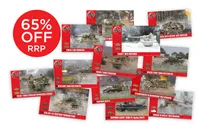
Prepare for an Epic Tank Odyssey at 1:35 scale with our Mega Tank Bundle!
Hold onto your helmets, because our tank bundle is here to take you into a thrilling world of armoured wonders! Featuring tanks from numerous decades and an expansive range of schemes, this bundle is an absolute must have for any true tank enthusiast.
What's Included
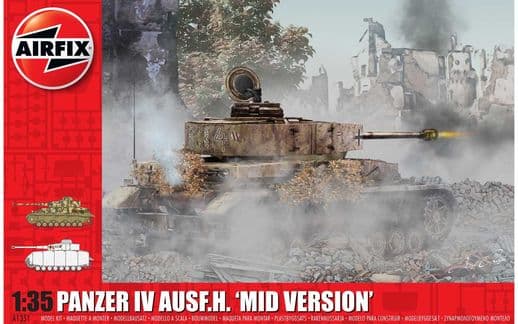
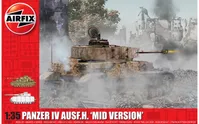
Panzer IV Ausf.H Mid Version
Product code: A1351
The German medium tank Panzerkampfwagen IV was developed in the late 1930s and was used extensively during WWII. The production of the Panzer IV Ausf. H started in June 1943. This version was designated the Sd. Kfz. 161/2. Compared to the previous variants, this model had Zimmerit paste on all the vertical surfaces of its armor in order to prevent adhesion of magnetic anti-tank mines.
The turret roof was reinforced from 10mm to 16 and 25mm segments. 5mm hull skirts and 8mm turret skirts were added for further protection, which resulted in the elimination of the vision ports on the hull side. Later on, the hull was also fitted with triangular supports for the easily damaged side skirts. Along with some other modifications, these additions to the design increased the tank's weight to 25 tones, and the maximum speed dropped to 16 km/h on cross country terrain.
Individual price: $20.00
- Item Scale
- 1:35 Scale
- Batteries Required
- No
- Item Length - Without Packaging (cm)
- 20.1
- Item Height - Without Packaging (cm)
- 7.66
- Item Width - Without Packaging (cm)
- 8.2
- Finish
- plastic
- Number of Scheme options
- 2
- Skill Level
- 3
- Flying Hours
- 3
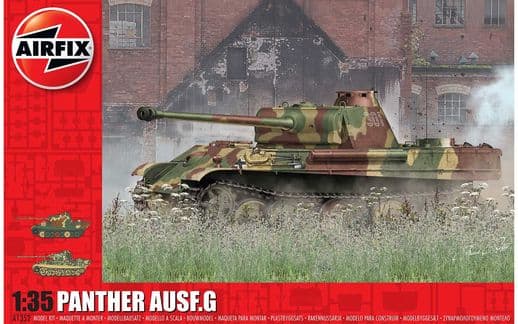
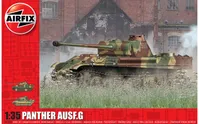
Panther G
Product code: A1352
On 3rd April 1944, M.A.N. reported that it had successfully completed trial production runs of the new Ausf.G chassis. M.A.N. built about 1143 Panther Ausf.G tanks between March 1944 and April 1945. Between July 1944 to March 1945 M.N.H. constructed 806 Panther Ausf.G tanks.
Daimler-Benz finished 1004 Panther Ausf.G tanks between May 1944 and April 1945. There were some minor differences between factory built tanks. M.N.H. fitted a cast steel Gleitschuh skid shoes instead of a rubber tire return roller behind the front track drive sprocket. The other two factories continued to fit rubber rimmed return rollers.
Individual price: $25.00
- Item Scale
- 1:35 Scale
- Batteries Required
- No
- Item Length - Without Packaging (cm)
- 24.7
- Item Height - Without Packaging (cm)
- 8.51
- Item Width - Without Packaging (cm)
- 9.8
- Finish
- plastic
- Number of Scheme options
- 2
- Skill Level
- 3
- Flying Hours
- 3
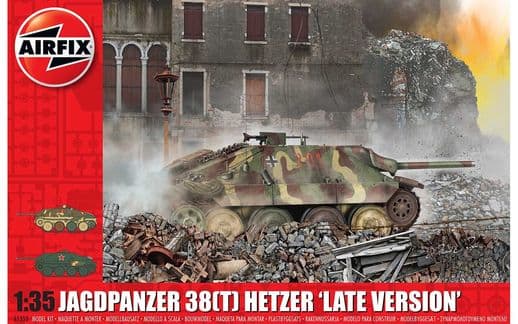
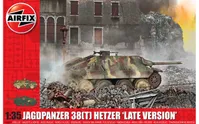
JagdPanzer 38(t) Hetzer ‘Late Version’
Product code: A1353
The Jagdpanzer 38(t) (Sd.Kfz. 138/2), later known as Hetzer (baiter), was a German light tank destroyer of the Second World War based on a modified Czechoslovakian Panzer 38(t) chassis. The project was inspired by the Romanian Mareºall tank destroyer. The name Hetzer was at the time not commonly used for this vehicle. It was the designation for a related prototype, the E-10.
The Skoda factory, for a very short period, confused the two names in its documentation and the very first unit equipped with the vehicle thus for a few weeks applied the incorrect name until matters were cleared. However, there exists a memorandum from Heinz Guderian to Hitler claiming that an unofficial name, Hetzer, had spontaneously been coined by the troops. Post-war historians basing themselves on this statement made the name popular in their works, the vehicle was never named as such in official documents.
Individual price: $19.00
- Item Scale
- 1:35 Scale
- Batteries Required
- No
- Item Length - Without Packaging (cm)
- 24.3
- Item Height - Without Packaging (cm)
- 6.2
- Item Width - Without Packaging (cm)
- 9.1
- Finish
- plastic
- Number of Scheme options
- 2
- Skill Level
- 3
- Flying Hours
- 3
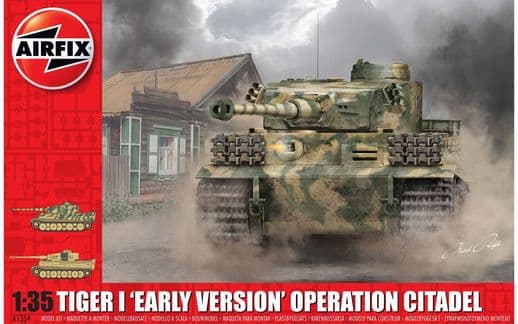
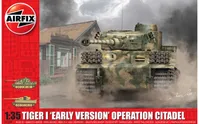
Tiger-1 Early Version - Operation Citadel
Product code: A1354
Following their disastrous defeat at Stalingrad during the winter of 1942-43, the German armed forces launched a major offensive in the East known as Operation Citadel on July 4th, 1943. The climax of Operation Citadel, the Battle of Kursk, involved as many as 6,000 tanks, 4,000 aircraft and 2 million fighting men and is remembered as the greatest tank battle in history.
The peak of the battle was the massive armor engagement at Prochorovka, which began on July 12th. Prochorovka is one of the best-known of the many battles on the Eastern Front during World War II. Tiger heavy tanks with deadly 88mm cannons, lumbered forward while hundreds of nimble Soviet T-34 medium tanks raced into the midst of the SS armor and threw the Germans into confusion. The Soviets closed with the Panzers, negating the Tigers 88mm guns, outmaneuvered the German armor and knocked out hundreds of German tanks.
The Soviet tank forces audacious tactics resulted in a disastrous defeat for the Germans, and the disorganized SS divisions withdrew, leaving 400 destroyed tanks behind, including between 70 and 100 Tigers and many Panthers. Those losses smashed the SS divisions fighting power, and as a result Hoths Fourth Panzer Army had no chance to achieve even a partial victory in the south of the Soviet Union. After receiving the news of the Allied invasion of Sicily, as well as reports of impending Soviet attacks on the Mius River and at Izyum, Hitler decided to cancel Operation Citadel. From then on the German forces were on the back-foot and the war had now turned against them.
Individual price: $30.00
- Item Scale
- 1:35 Scale
- Batteries Required
- No
- Item Length - Without Packaging (cm)
- 24.1
- Item Height - Without Packaging (cm)
- 8.57
- Item Width - Without Packaging (cm)
- 10.2
- Finish
- plastic
- Number of Scheme options
- 2
- Skill Level
- 4
- Flying Hours
- 3
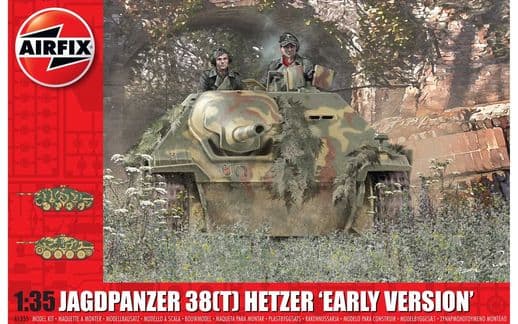
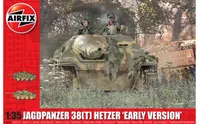
JagdPanzer 38(t) Hetzer ‘Early Version'
Product code: A1355
The Jagdpanzer 38 (Sd.Kfz. 138/2), later known as Hetzer ("baiter"), was a German light tank destroyer of the Second World War based on a modified Czechoslovakian Panzer 38(t) chassis. The project was inspired by the Romanian "Mareºall" tank destroyer. The Jagdpanzer 38 was intended to be more cost-effective than the much more ambitious Jagdpanther and Jagdtiger designs of the same period.
Using a proven chassis, it avoided the mechanical problems of the larger armored vehicles. It was built on the Panzerkampfwagen 38(t)s widened and lengthened chassis with modified suspension (larger road-wheels from Praga TNH n.A prototype reconnaissance tank) and up-rated engine. The new engine was 160 PS Praga AC/2 6-cylinder engine controlled by Praga-Wilson gearbox (5 forward and 1 reverse gear). Chassis was modified in order to accommodate larger gun and thicker armor than regular Panzerkampfwagen 38(t) tank. Its combat weight was 16 metric tons (versus 9.8-tonnes for the Pz 38(t) and it could travel at maximum speed of some 42 km/h.
Individual price: $19.00
- Item Scale
- 1:35 Scale
- Batteries Required
- No
- Item Length - Without Packaging (cm)
- 24.3
- Item Height - Without Packaging (cm)
- 6.2
- Item Width - Without Packaging (cm)
- 9.1
- Finish
- plastic
- Number of Scheme options
- 2
- Skill Level
- 3
- Flying Hours
- 3
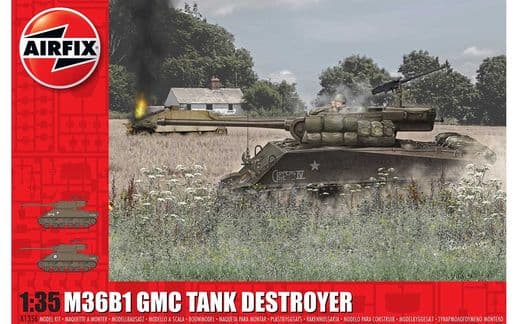
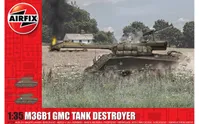
M36B1 GMC (U.S. Army)
Product code: A1356
The M36 tank destroyer, formally 90 mm Gun Motor Carriage, M36, was an American tank destroyer used during World War II. The M36 combined the hull of the M10 tank destroyer, which used the M4 Sherman's reliable chassis and drivetrain, combined with sloped armor. Conceived in 1943, the M36 first served in combat in Europe in October 1944, where it partially replaced the M10 tank destroyer.
However, when coming up against the heaviest tanks of the Wermarcht at the end of that year, the need for 90 mm gunned tank destroyers became urgent and during October-December 1944, 187 conversions of standard Medium Tank M4A3 hulls were produced by Grand Blanc Arsenal. These vehicles, designated M36B1, were rushed to the European Theater of Operations and used in combat alongside standard M36s.
Individual price: $25.00
- Item Scale
- 1:35 Scale
- Batteries Required
- No
- Item Length - Without Packaging (cm)
- 21.3
- Item Height - Without Packaging (cm)
- 9.37
- Item Width - Without Packaging (cm)
- 8.7
- Finish
- plastic
- Number of Scheme options
- 2
- Skill Level
- 3
- Flying Hours
- 3
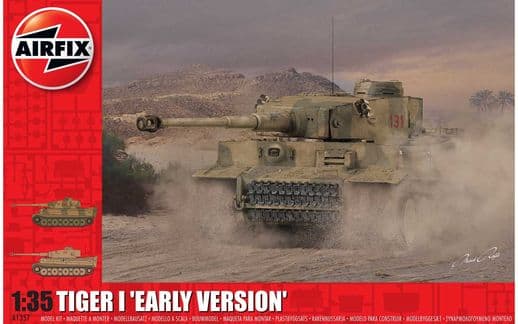
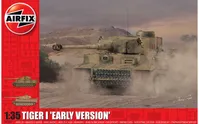
Tiger 1, Early Production Version
Product code: A1357
Production of the Tiger I began in August 1942 at the factory of Henschel und Sohn in Kassel, initially at a rate of 25 per month and peaking in April 1944 at 104 per month. 1,355 had been built by August 1944, when production ceased. Deployed Tiger I's peaked at 671 on 1 July 1944. It took about twice as long to build a Tiger I as another German tank of the period.
When the improved Tiger II began production in January 1944, the Tiger I was soon phased out. Eager to make use of the powerful new weapon, Hitler ordered the vehicle be pressed into service months earlier than had planned. A platoon of four Tigers went into action on 23rd September 1942 near Leningrad. Operating in swampy, forested terrain, their movement was largely confined to roads and tracks, making defense against them far easier.
Many of these early models were plagued by problems with the transmission, which had difficulty handling the great weight of the vehicle if pushed too hard. It took time for drivers to learn how to avoid overtaxing the engine and transmission, and many broke down. The most significant event from this engagement was that one of the Tigers became stuck in swampy ground and had to be abandoned. Captured largely intact, it enabled the Soviets to study the design and prepare countermeasures.
Individual price: $22.00
- Item Scale
- 1:35 Scale
- Batteries Required
- No
- Item Length - Without Packaging (cm)
- 24.1
- Item Height - Without Packaging (cm)
- 8.57
- Item Width - Without Packaging (cm)
- 10.2
- Finish
- plastic
- Number of Scheme options
- 2
- Skill Level
- 3
- Flying Hours
- 3
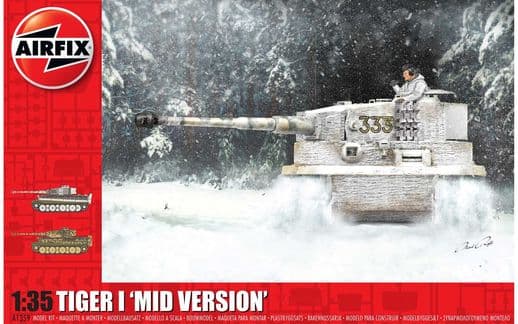
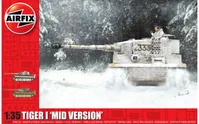
Tiger-1 Mid Version
Product code: A1359
The Tiger I was a German heavy tank of World War II deployed from 1942 in Africa and Europe, usually in independent heavy tank battalions. Its final designation was Panzerkampfwagen VI Tiger Ausf. E often shortened to Tiger. The Tiger I gave the Wehrmacht its first armored fighting vehicle that mounted the 8.8 cm KwK 36 gun.
1,347 were built between August 1942 and August 1944. It carried a crew of 5 (driver, radio operator, gunner, commander and loader), and was powered by a water-cooled V-12 engine, taking to speeds up to 28 m.p.h. (45 k.m.p.h.), and along with its feared main weapon carried two 7.92mm MG-34 machine guns, used in close combat situations. While the Tiger I has been called an outstanding design for its time, it was arguably over-engineered using expensive materials and labor-intensive production methods. The Tiger was prone to certain types of track failures and breakdowns, and was limited in range by its high fuel consumption.
It was expensive to maintain, but generally mechanically reliable. Also being difficult to transport, and vulnerable to immobilization when mud, ice, and snow froze between its overlapping and interleaved Schachtellaufwerk-pattern road wheels, often jamming them solid, made the effectiveness of this fearsome weapon less potent. This was a problem on the Eastern Front in the muddy spring season and during periods of extreme cold.
The tank was given its nickname "Tiger" by Ferdinand Porsche, and the Roman numeral was added after the later Tiger II entered production. The initial designation was Panzerkampfwagen VI Ausführung H (Panzer VI version H, abbreviated PzKpfw VI Ausf. H) where 'H' denoted Henschel as the designer/manufacturer. It was classified with ordnance inventory designation SdKfz 182. The tank was later re-designated as PzKpfw VI Ausf. E in March 1943, with ordnance inventory designation SdKfz 181. Mid-production Tiger I's have the second design turret with the smaller cupola but retain the rubber-rimmed roadwheels.
Individual price: $27.00
- Item Scale
- 1:35
- Batteries Required
- No
- Item Length - Without Packaging (cm)
- 24.1
- Item Height - Without Packaging (cm)
- 8.57
- Item Width - Without Packaging (cm)
- 10.2
- Finish
- plastic
- Number of Scheme options
- 2
- Skill Level
- 3
- Flying Hours
- 3
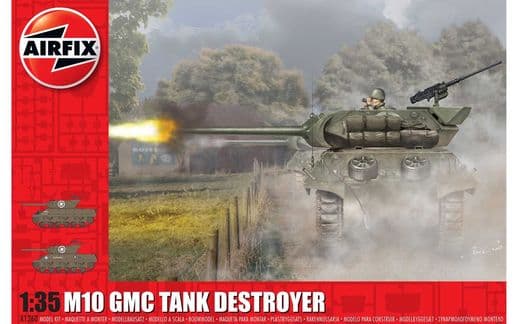
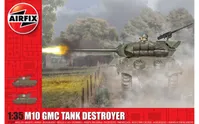
M10 GMC Tank Destroyer
Product code: A1360
The American M10 tank destroyer served during WWII. After the US entry into World War II and the formation of the Tank Destroyer Force, a suitable vehicle was needed to equip the new battalions. By November 1941, the Army requested a vehicle with a gun in a fully rotating turret after previous models were criticized for being too poorly designed.
The prototype of the M10 was developed in early 1942, and was delivered in April of that year. After requested changes to the hull and turret, the modified version was readied for production in June 1943, appearing as the 3-inch Gun Motor Carriage M10. It mounted a 3-inch (76.2 mm) Gun M7 in a rotating turret on a modified M4A2 Sherman tank chassis.
Productions ran from September 1942 to December 1943. The M10 was numerically the most important U.S. tank destroyer of World War II. It combined thin but sloped armor with the M4 Sherman's reliable drivetrain and a reasonably potent anti-tank weapon mounted in an open-topped turret. Despite its obsolescence in the face of more powerful German tanks like the Panther and the introduction of more powerful and better-designed types as replacements, the M10 remained in service until the end of the war.
Individual price: $25.00
- Item Scale
- 1:35 Scale
- Batteries Required
- No
- Item Length - Without Packaging (cm)
- 19.5
- Item Height - Without Packaging (cm)
- 8.29
- Item Width - Without Packaging (cm)
- 8.7
- Finish
- plastic
- Number of Scheme options
- 2
- Skill Level
- 3
- Flying Hours
- 3
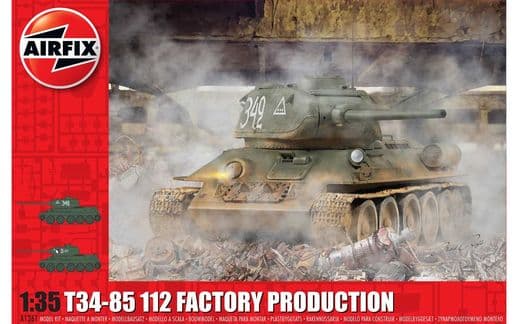
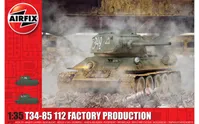
T34-85 112 Factory Production
Product code: A1361
When the first T-34-85s (85mm gun) delivered by Zavod #112 appeared, they were given to the best units, the elite Red Guards battalions. However, they were in training during December 1943, so it is uncertain whether they saw action before January or February 1944.
By then, around 400 had already been delivered to front-line units and instantly became popular with the crews. They gradually replaced the T-34/76 and in mid-1944 the T-34-85 outnumbered the older versions. By then they formed the bulk of the tank units on the eve of Operation Bagration, the Soviet response to the Allied landings in Normandy, and the biggest offensive ever planned by the Red Army to date. This was the final push, aimed at Berlin. Before the production built-up, the T-34-85 model 1943 were usually given to chosen crews, usually of the Guard units.
Individual price: $22.00
- Item Scale
- 1:35 Scale
- Batteries Required
- No
- Item Length - Without Packaging (cm)
- 19.1
- Item Height - Without Packaging (cm)
- 7
- Item Width - Without Packaging (cm)
- 8.6
- Finish
- plastic
- Number of Scheme options
- 2
- Skill Level
- 3
- Flying Hours
- 3
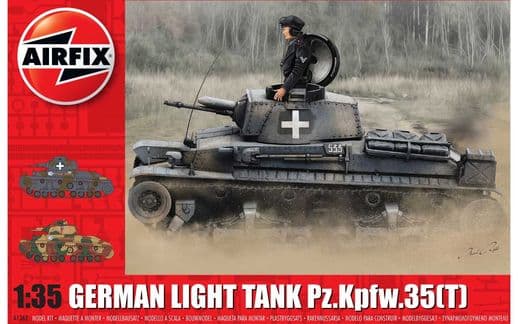
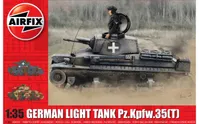
German Light Tank Pz.Kpfw.35(t)
Product code: A1362
The Panzerkampfwagen 35(t), commonly shortened to Panzer 35(t) or abbreviated as Pz.Kpfw. 35(t), was a Czechoslovakian designed light tank used mainly by Nazi Germany during World War II. The letter (t) stood for tschechisch (German: "Czech"). In Czechoslovakian service it had the formal designation Lehký tank vzor 35 (Light Tank Model 35), but was commonly referred to as the LT vz. 35 or LT-35. A total of 434 were built; of these, the Germans seized 244 when they occupied Bohemia-Moravia in March 1939 and the Slovaks acquired 52 when they declared independence from Czechoslovakia at the same time. Others were exported to Bulgaria and Romania.
In German service, it saw combat during the early years of World War II, notably the invasion of Poland, the Battle of France and the invasion of the Soviet Union before being retired or sold off in 1942; the fighting in Russia having exposed the vehicle's unsuitability for cold weather operations and general unreliability. This weakness, in addition to their thin armor and inadequate firepower, resulted in the 6th Panzer Division being re-equipped with other more powerful German tanks on its withdrawal from Russia in April 1942.
Individual price: $17.00
- Item Scale
- 1:35 Scale
- Batteries Required
- No
- Item Length - Without Packaging (cm)
- 14
- Item Height - Without Packaging (cm)
- 6.77
- Item Width - Without Packaging (cm)
- 5.9
- Finish
- plastic
- Number of Scheme options
- 2
- Skill Level
- 3
- Flying Hours
- 3
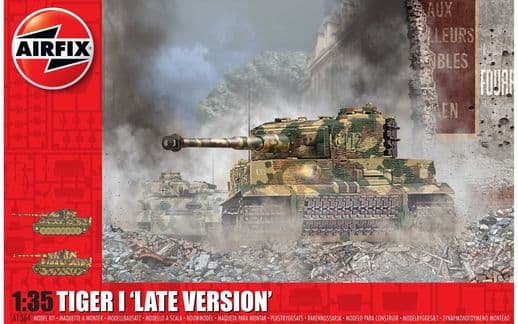
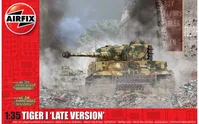
Tiger-1 "Late Version"
Product code: A1364
Now you can build really big model Tanks thanks to Airfix's new range. These are big 1:35 scale models. Once complete, from gun tip to rear exhaust you'll have a model stretching 41cm across your workbench. The kit comprises the hull, turret and running gear as you'd expect. However, this kit includes a set of interior details!
You can leave the model with a turret ready to lift off and show off your surprise the detailed interior! The initial range of 1:35 kits from Airfix features over a dozen classic Tanks the Tiger being an obvious choice to start of your modelling in 1:35 scale.
This kit includes 15 sprues of plastic parts for you to assemble and paint, plus additional items for the vinyl components. There is even a detailed set of etched engine grills included. Add to this a new and fully researched assembly manual, decal sheet and two paint schemes. You'll get hours of enjoyment from this large-scale model Tank.
Individual price: $27.00
- Item Scale
- 1:35 Scale
- Batteries Required
- No
- Item Length - Without Packaging (cm)
- 24.1
- Item Height - Without Packaging (cm)
- 8.37
- Item Width - Without Packaging (cm)
- 10.2
- Finish
- plastic
- Number of Scheme options
- 2
- Skill Level
- 3
- Flying Hours
- 3
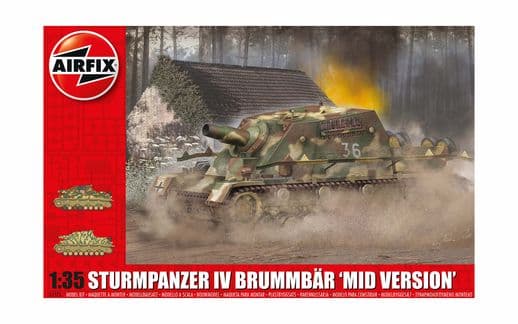
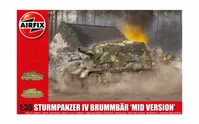
Sturmpanzer IV Brummbar (Mid Version)
Product code: A1376
The Sturmpanzer IV is often referred to as the Brummbär, which roughly translates to grumbling or bad-tempered bear, but it is thought that this was an Allied reporting name for the vehicle and not one actually used by the Germans - they simply referred to the assault tank as a Stupa 43, a direct reference to the gun the vehicle used. The Sturmpanzer served with 4 Assault Battalions, with Sturmpanzer-Abteilung 216 being the first committed to combat during Operation Zitadelle and the mighty clash of armor in the Kursk salient. These vehicles would go on to see significant action throughout the Soviet Union, as well as in Poland, Italy and the Battle of Normandy, although as was the case with most German armor during the latter stages of the war, there were never enough serviceable Sturmpanzers available at any one time and as mounting losses could not be replaced effectively, their operational numbers dwindled steadily as the fighting intensified.
Around 306 Sturmpanzer IVs were built, with only three or four of the distinctive armored fighting vehicles surviving in various museums to this day.
Individual price: $30.00
- Item Scale
- 1:35 Scale
- Batteries Required
- No
- Item Length - Without Packaging (cm)
- 17
- Item Height - Without Packaging (cm)
- 7.7
- Item Width - Without Packaging (cm)
- 8
- Finish
- plastic
- Number of Scheme options
- 2
- Skill Level
- 3
- Flying Hours
- 3